
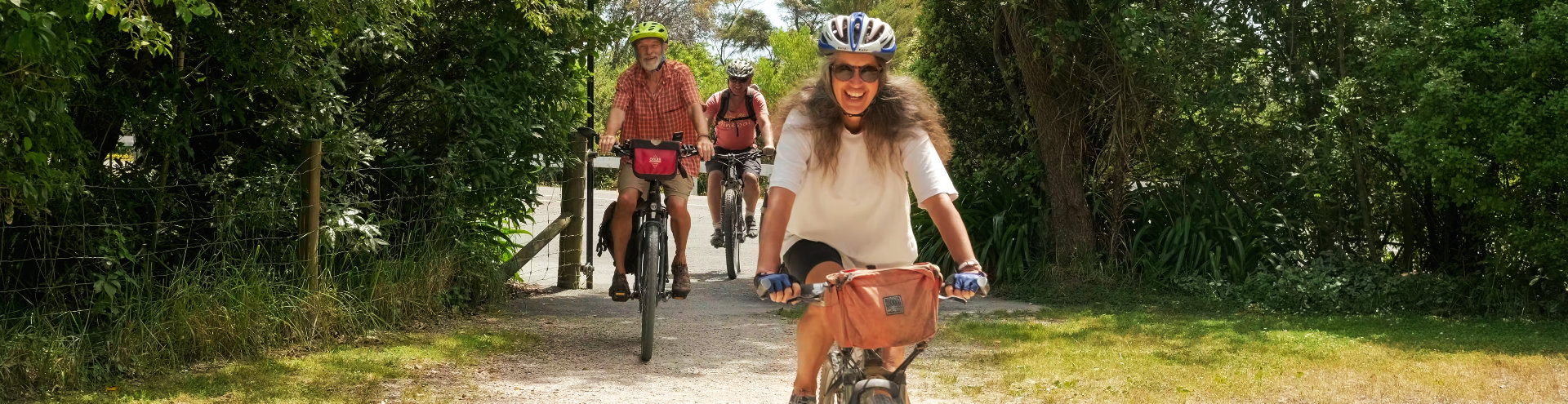
“Truly epic” coast-to-coast walking and cycling trail to unite Golden Bay communities
A walking and cycling group has moved closer to creating a spectacular off-road link between Picton and the West Coast, while also bypassing a “horrendously dangerous” road for residents.
When its Pledge Me campaign to fund the first section of the planned 27km, Tākaka-to-Collingwood cycling and walking trail closed at the end of January, the Golden Bay Cycle and Walkways Society had more than doubled its $40,000 target.
Axel Downard-Wilke, the society's chair, put the outstanding support partly down to enthusiasm for the section becoming a crucial link in an “amazing” pathway linking the Marlborough Sounds to the West Coast, via two National Parks, two Great Walks and some of New Zealand’s most spectacular coastal scenery.
That new pathway could then become a vital, and beautiful, part of the national network of “Great Rides”, he says.
“There are currently 23 partners in the Great NZ Cycle Trail. We want to be the 24th. Our pathway is right up there. Scenic value, passing through absolutely beautiful nature, connecting communities… It just fits together so well.”
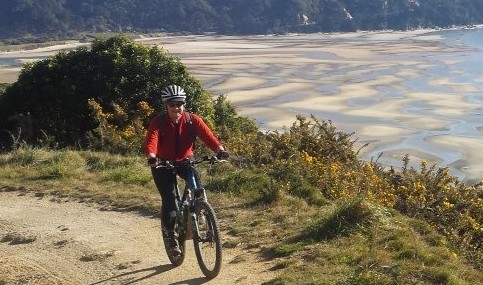
The new Golden Bay pathway could become a beautiful part of the national network of “Great Rides”.
The fundraising campaign was exciting in itself, Axel says.
“With Pledge Me, you set a target, and if you don’t reach it, you get nothing. We also had a generous backer, Mark Carnegie, who pledged to match public donations up to $40,000, which he then upped to $50,000. So, a lot of people were watching the total very closely. And we ended up with nearly $100,000. We are blown away by the support, and very grateful.”
Afterwards, Axel and his collaborators spent an entire evening fielding congratulations at the Mussel Inn, the renowned pub and live music venue in Onekaka.
Axel says the Inn is a major hub and backer of the pathway project, and of the wider Golden Bay community, making it the natural start for Stage 1.
That stage will head west for about 5km to the coastal settlement of Parapara.
Safety, connectivity, and public access
Axel says the other major reason for the community’s enthusiasm for the funding drive was how keenly it feels the lack of a safe, non-motorised, off-road, public access link between Golden Bay’s two main population centres — Tākaka and Collingwood.
Consultation shows the community is desperate for a safe alternative, he says.
“Currently, the only safe way to get to the northern half of Golden Bay is to hitchhike or drive."
He says the standard width of a rural highway is 7 metres wide, whereas State Highway 60 between Tākaka and Collingwood is often only 6 metres, and there’s no shoulder.
“Cars and trucks are doing 100 kilometres an hour and there’s no room for anyone else. It’s absolutely horrendously dangerous to cycle or walk on it. It is just such a skinny road.”
The new off-road trail will largely run parallel to the highway, but will leave it where necessary, further showing off the region’s scenic terrain.
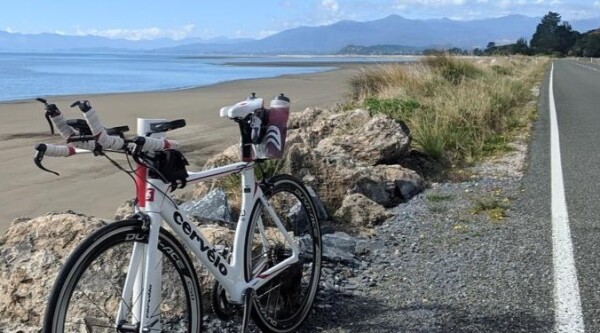
The planned Golden Bay trail is part of a larger goal to create a spectacular walking and cycling pathway from Picton to the West Coast.
To facilitate the first section, six private landowners have already agreed to easements over their land, as well as DOC. The legal work on the easements is well underway.
Axel says having that type of concrete backing from landowners, the NZ Transport Agency Waka Kotahi, the Department of Conservation, and the Outdoor Access Commission has been fabulous.
“The Tasman District Council is on board too – they have seen what an asset, for example, the Nelson-Tasman Great Taste Trail is, and they are very keen on the prospect of eventually linking up with that. The question is not whether we achieve the vision. The question is how long it will take us.”
Having secured such generous community support, the society applied in late February for an additional $230,000 from the Lotteries Commission. If that is granted, construction on the Onekaka-Parapara section will start in October.
Axel says it’s important to continue making tangible progress toward the larger goal.
“We want to show the community what it feels like, what it looks like, to have a high-quality, safe, scenic, off-road walking and cycling connection. It’s hard to get people on board if it’s abstract.”
The route will be completely separated from traffic, so unaccompanied children can use it safely.
An epic goal
The Tākaka-Collingwood link is part of a larger plan. The Society’s ultimate vision is a “truly epic” coast-to-coast cycle and walking experience from Picton to the West Coast, Axel says.
Sections of this approximately 350km adventure would include:
- The Great Taste Cycle Trail through Nelson-Tasman, and an extension from Picton that is currently underway
- A water taxi or kayak around the Abel Tasman National Park, or the Great Walk through it
- The planned Golden Bay trail from Tōtaranui in the Abel Tasman, via Tākaka and Collingwood to the Aorere Valley entrance to Kahurangi National Park
- And finally, another Great Walk or ride, the Heaphy Track, to the West Coast.
“Long-distance cycle touring from Picton to the West Coast — how good is that?” says Axel.
And it’s not just a vision. Sections of the wider Golden Bay network already completed include the Tākaka–Paines Ford and Tākaka–Pōhara trails, as well as the Heartland Ride from Collingwood to the Aorere Valley end of the Heaphy Track.
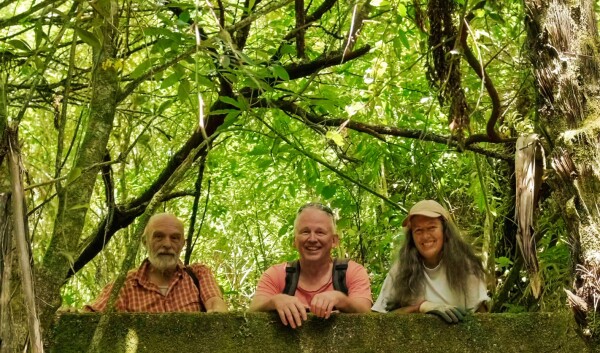
Members of the Golden Bay Cycle and Walkways Society check out a possible trail section over an historic bridge from the days of the Onekaka Ironworks tram. From left: Erhard Wingels, Axel Downard-Wilke, Debbie Pearson.
The community at the handlebars
Axel’s professional background stands him in good stead for project-managing the planned trail. A civil engineer, he has decades of experience in the field of sustainable transport: especially public transport, walking, and cycling.
His company, ViaStrada, created the New Zealand Cycle Trails Design Guide, which contains design specifications for the national network of cycle trails, Ngā Haerenga.
But despite these skills and experience, and those of the other self-acknowledged “cycling nuts” in the Society, Axel says it’s two other groups of people who will be most instrumental in completing the trail.
The first is the trail’s advisory board, which represents a broad cross-section of the wider community — from Federated Farmers and Rural Women NZ, through to the industry, tourism, and education sectors.
The second key group, Axel says, is that wider community itself.
“Up until this point, it has been our society that has shepherded the project. But what I really want is for the wider community to own it.
“For example, at the moment, the planned path largely follows the highway, for practical reasons. But it doesn’t have to. If landowners want it to go closer to the coast to make it more scenic, and if they allow it to pass through their properties, then why not?
“The society can’t make that happen, but the community can, landowners can.”
Axel says another key supporter is the local newspaper, The GB Weekly.
So, how confident is he that the trail will become a reality?
“Look, when you’ve got a really good project, it’s irrelevant whether you’ve got the dollars to start with. If it’s good enough, the money will come. It will happen.”
More information on the project: The Golden Bay Cycle and Walkways Society